Posts

Showing posts with the label Sales Of Goods Act

Sales of goods act - Sale by non-owners

Introduction Generally, owner is entitle to sale the goods, or his agent, or some authority he had appointed. What if non owner sales the goods which he don't have authority to ? Suppose You sell Mr Mallya, ferrari owned by Sachin, will Mr Mallya become real owner ? Well the obvious answer is "No" but sales of goods act provides some scenarios under which sale by non-owner become sale. Nemo dat quod non habet, Section 27 states that when seller don't have authority, then buyer will have same title (Or no better title) as that of seller. Section is as below Subject to the provisions of this Act and of any other act for the time being in force, where goods are sold by person who is not the owner thereof and who does not sell them under the authority or with the consent of the owner the buyer acquires no better title to the goods than the seller had The underlying principle is Nemo dat quod non habet, meaning "no one can transfer better title tha...
Sales of Goods Act - Transfer of ownership in Un-ascertained Goods

Introduction In this article we have discussed why we need to study transfer of ownership as well as transfer of ownership of specific goods. In this blog we will cover how ownership is transferred in case of un-ascertained goods. Section 23 deals with such transfer. Un-ascertained goods are those goods which are yet to be identified or ascertained for the purpose of contract How ? Suppose if you go to Mr Bangur for Bangur cement and enter into contract for 100 bags of cement. Mr Bangur have very big godown where he have thousands of cement bags. In such scenario how will you determine when exactly the ownership is transferred. There are few things Un-ascertained goods first have to be turned into ascertained goods. Meaning you have to assign certain goods to contract. This is also known as appropriation. In above example, it would mean selecting 100 bags of cement out of thousands of bags from godown. This appropriation or selecting of goods out of un-ascertai...

Sales of Goods Act- Transfer of ownership in Specific Goods

Introduction We have discussed definition of goods, types of goods in this article . To understand when exactly ownership is transferred from one person to another, it is first necessary to understand definition of goods and it's classification. Specific goods are such goods which are identified at the time of contract of sale. We will discuss here when the ownership passes from seller to buyer in these goods. Section 19, 20, 21,22 and 24 of the act deal with transfer of ownership. Why we even need to know about passing of ownership ? There are tons of reason. Suppose Mr Mallya and Mr Choksi enter into contract of sale of truck of beer. Let's assume Mr Mallya is seller and Mr Choksi is buyer. What if ??? Beer got destroyed after contract, who will bear the loss ? If anyone of them become insolvent, whos assignee will get the money ? Or may be get a beer to drink ? In above scenarios it become important to understand who was the owner of the property. Pro...

Sales of Goods Act- Warranties and Implied Warranties

Introduction We have seen what is warranties and condition in this article. Warranties are not essentials but such stipulations breach of which give rise buyer to seek damages. If you buy a fan, it is working fine, but it produces some noise which is bearable. Now this is some kind of defect for which you cannot repudiate the contract. You can mention whatever you want in your contract as to warranties. For example you want to buy some desktops, you can give definite description of whatever you want, and also mention if this and this thing is breached it will be treated as breach of warranties. Apart from express warranties, Sales of Goods act provide certain implied warranties, in absence of any express contract.  these are as below Implied Warranties Warranty of quiet possession (Sec -14(b)) It mean, after delivery , nobody should disturb the buyer. Buyer should able to enjoy the property without any disturbances. For example you buy a car from Mr Mallya,...

Sales of Goods Act- Conditions and Warranties-Implied Condition

Introduction You order tailor made expensive suit for you marriage on 16th January. You specifically ask the retailer to deliver the suit on 15th January. Instead on 15th, retailer delivered the suit on 20th. What will you do with this suit ? Will you burn it ? Will You return it ? Will you use it as floor cleaner ? Or more importantly, will you pay for this suit ? From above example it's very easy to understand what does "Condition" mean and what does "Warranty" mean. "Condition" in the context of sales of goods act mean, some stipulations which are utmost necessary for the main purpose of the contract, the breach of which give rise to void the contract, repudiate the contract. In above example, delivery of suit was extremely essential as it has to be for particular purpose. On breach of this what would be use of suit ? Warranties on other hand related stipulations which are not essential to the purpose of contract. But they are colla...

Sales of Goods Act- Caveat Emptor and it's exception

Caveat Emptor This is simple thing. It puts responsibility in certain condition on buyer to be aware of the goods are buying. It is also know as "Buyer beware". For example if you go for buying an I-phone, you know that phone sucks, but still you buy that phone by selling a kidney, and later say this phone sucks, then in this case you wont get any damages or repudiate the contract. You already knew that phone is not worth selling kidney. It's your negligence. For it neither you can ask for damages, or neither you will able to repudiate the contract It puts some responsibility on buyer as well. Exception to caveat emptor What if goods that you are buying have defect which still you cannot notice ? Can you void such contract ? Will you be able to get damages ? Even though buyer should be aware and should not observe negligence in certain condition, even if he is negligent, some implied condition still will be applicable. 1) Condition as to Quality or Fit...

Sales of Goods Act- Effect of Perishing Goods

Effects of perishing Goods Assume, you have contract to buy horse from Mr Mallya. You made a contract. Now at the time of making contract, Horse died in stable which Mr Mallya don't know. Now what ? Will you get money back ? Will Mr Mallya get money because he didn't know whether Horse died or not ? These questions are answered in section 7. Section 7 states as below Where there is a contract for sale of specific goods, the contract is void if the goods without the knowledge of the seller have at the time when the contract was made, perished or become so damaged as no longer to answer to their description in the contract When subject matter of contract is destroyed, performance of contract becomes impossible and hence contract becomes void. In above example, you have selected horse, but it died without the fault of seller and he cannot bring that horse back to life. Similarly say you ordered 1 ton of Bananas. Monkey had destroyed Bananas beyond recognition...

Sales of Goods Act : Hire Purchase Agreement and difference with Contract of Sale

Hire Purchase Agreement There is separate act which deals with hire purchase which is Hire Purchase Act, 1972.   To give a lay idea, I want to drive a car, but I don't have enough money. What I do is I go to "Mallya Car Showroom" wherein I agree to pay showroom some monthly sum say 10000 Rs and I will drive a car. I agree to pay that installment for 24 months, after last installment I will become rightful owner of a Car, in case of default of payment, Showroom can take back their good. This is nothing but the hire purchase agreement in a crude sense. To define it more technically, it is an agreement  under which goods are let on hire and under which the hirer has an option to purchase them in accordance with the agreement and include under which Possession of goods is delivered by owner to hirer on condition that hirer will pay the requisite sum  Property or ownership will pass after the last installment Hirer has right to terminate the agreement at any ti...

Sales of Goods Act- Difference between Agreeement to Sale and Contract of Sale

Agreement To Sale If transfer of property takes place at the time of making a contract,it will be contract of Sale as discussed here . But when the transfer of property in the goods is to take place at the future time or subject to some conditions thereafter to be fulfilled, then it will be called as agreement to sell. For example if A agrees to sale wheat which is growing in his farm after harvest to B, then it will be a agreement to sale. Difference between agreement to sale and Contract to Sale Transfer of property : In contract of sale ownership is transferred to buyer as soon as contract is executed, whereas in agreement to sell, ownership in transfer will be transferred in future date or completion of certain condition imposed upon buyer. Types of Goods : Subject matter of contract of sale is specified goods or existing goods as good has to be determined at the time of contract. Whereas in agreement to sale, goods could be future goods as well apart from E...

Sales of Goods Act - Definition of Contract of Sales

Definition A contract of sale of goods is a contract whereby the seller transfers or agrees to transfer the property in goods to the buyer for a price. There may be a contract of sale between one part-owner and another Contract of sales is defined as above in sales of goods act. Essentials things are as below Contract between two parties, buyer and seller Subject matter of Contract is "Goods" Seller to transfer or agree to transfer the property, ownership in the goods Consideration is money   Contract between two parties, buyer and seller  Act stipulates that Contract of Sale must have two parties. Seller is a person who sells or give off the possession of goods, whereas buyer is a person who take possession or property in goods. Can a same person buy his own property ? Possibly. Say your property is attached by a bank for default of loan payment. In Auction of your property you buy that same property. Nevertheless, this is sale! One important...

Sales of Goods Act - Actual, Symbolic and Constructive Delivery (Types of Deliveries)

Section 2(3) defines what a "delivery mean". It states as below (2) "delivery" means voluntary transfer of possession from one person to another; It is simply a voluntary transfer. This is similar to Free consent discussed in Contract At. It includes below type of deliveries Actual Delivery: When goods are actual delivered to a person. For example Mr Ajay Devgan orders 1000 Units of Vimal Pan Masala. When seller deliver this to his house or place agreed  by them, it will be called as actual delivery. Constructive Delivery: In this case, delivery appears to be done, even thought physical delivery is not done. For example if A sells 10 Tons of rice to B which is in godown of A. If transaction is done, and ware house person is holding goods transferred to B at the request of A, it will be called as constructive delivery. It is necessary in this case that this warehouse guy knows that now goods belong to A. Symbolic Delivery: Sometimes delivery become d...

Sales of Goods Act - Definition of Goods and Classification of goods

Image
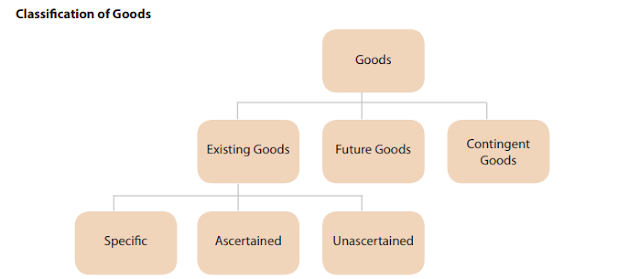
Introduction Scope or subject matter of Sales of Goods act is "Goods". No exhaustive definition is provided which have enlisted all the goods. However definition is clear about what is included and what is excluded. Further, judicial decision also lead clarity to what all kind of things are covered by Sales of Goods act. First, it's important to understand WHY it's necessary to have solid definition for "Goods". First, State impose taxes when any transaction is carried out in "Goods". So to figure out if anything taxable or not, we need to find out whether it is "Goods" as per law. Second, there are certain rights and duties when transaction is done in "Goods". If you go to court about rights, first thing need be figured out is whether your transaction was in "Goods" as per act. Definition Section 2(7) defines goods as below: "goods" means every kind of moveable property other than actio...

Followers